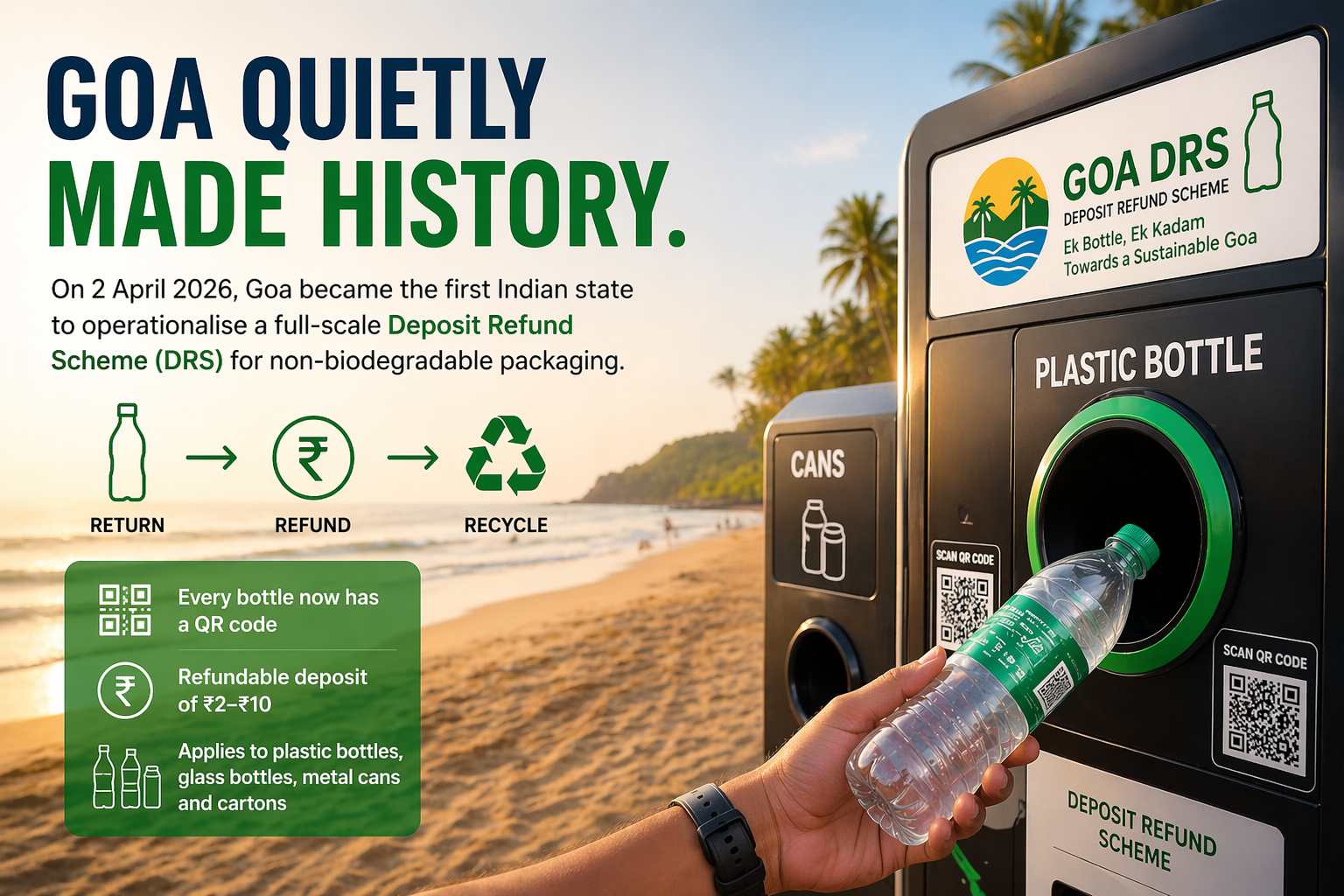
On 2 April 2026, Goa officially became the first Indian state to announce a full-scale Deposit Refund Scheme (DRS) for non-biodegradable packaging.
Backed by a government notification dated 23 October 2025, the system is now live—bringing together QR code tracking, refundable deposits, and large-scale recycling infrastructure.
Not Yet Started, but might be implemented from Next Financial Year.
This isn’t just a policy shift—it’s a game-changing model for India’s liquor and waste management ecosystem.
What Has Changed in Goa?
All eligible packaging—including:
- Glass bottles (liquor, beer, wine)
- Plastic bottles
- Metal cans
- Liquid cartons
…now carry:
- A unique QR code for identification
- A refundable deposit ranging from ₹2 to ₹10
Consumers can recover this deposit by returning empty containers at designated collection points.
Massive Rollout Plan
The Goa government has designed a scalable infrastructure:
- 300 Reverse Vending Machines (RVMs) in Phase 1
- Expansion to 500 machines within 3 years
- 150+ manual collection centres across the state
This ensures accessibility across urban hubs, tourist zones, and villages.
Awareness on Ground: Nadora Gram Sabha Initiative
To build public participation, the government has already started grassroots awareness campaigns.
At the Nadora Gram Sabha in Bardez, officials conducted a live awareness drive:
- Educated residents about returning non-biodegradable packaging
- Explained eligible containers and refund process
- Demonstrated the system through a live Reverse Vending Machine (RVM) experience
- Highlighted digital QR-based verification
The village Sarpanch encouraged residents to actively participate, stressing that cleanliness and environmental responsibility are core community values in Goa.
This shows the scheme is not just policy-driven—it’s community-led adoption in action.
How the Goa DRS System Works (Step-by-Step)
1. Manufacturer Pays Deposit Upfront
Every time a QR code is generated, the manufacturer deposits the matching value into a central escrow account.
2. Deposit Moves Through Supply Chain
The deposit flows from manufacturer → distributor → retailer, ensuring accountability at every level.
3. Consumer Pays Deposit
At purchase, the buyer pays:
- Product price
- Refundable deposit (₹2–₹10)
4. Return of Empty Packaging
Consumers return used packaging at:
- RVM machines
- Collection centres
5. Instant Refund
The deposit is refunded via:
- Digital payment (UPI likely)
- Or other approved methods
6. Digital Tracking & Transparency
Every return is:
- Logged via QR scan
- Recorded in real-time dashboards
- Accessible to regulators and manufacturers
Who Manages the Scheme?
The scheme is governed by the
Goa Coastal & Environment Management Society (GC&EMS)
Role of GC&EMS:
- Overall implementation and monitoring
- Managing the DRS ecosystem
- Defining eligible packaging categories
Covered Materials:
- Glass bottles
- Metal cans
- Rigid plastics
- Flexible plastics
- Laminated cartons (LPB)
- Multi-layered plastics (MLPs)
Why This Matters for Goa (and India)
1. Cleaner Recycling System
DRS creates single-stream, high-quality recyclable material, essential for:
- Food-grade rPET
- High-quality rHDPE
2. Big Boost to Sustainability
- Reduces landfill waste
- Improves recycling rates dramatically
- Supports circular economy
3. Strong Liquor Industry Regulation
With QR codes + DRS:
- Counterfeit alcohol becomes harder
- Every bottle is traceable end-to-end
4. National Impact
States like Himachal Pradesh have already approved similar pilot programs for 2025–26.
👉 Goa is now the benchmark model for India.
What This Means for Businesses in Goa
Liquor Shops & Retailers:
- Must sell QR-coded bottles only
- Need to educate customers on deposit refunds
- Opportunity to increase customer engagement
Hotels, Bars & Clubs:
- Likely to act as collection hubs
- Can position themselves as eco-conscious brands
- Ideal for integration into premium hospitality experiences
Challenges to Watch
- Consumer awareness (still growing)
- Logistics of collection in high-tourism zones
- Storage & transport of returned packaging
- Adoption speed among small retailers
Goa didn’t just introduce another policy—it built a fully integrated ecosystem combining technology, sustainability, and regulation.
From QR-coded liquor bottles to real-time recycling tracking, the state is setting a new benchmark for India.
If executed well, this could redefine how:
- Liquor is sold
- Waste is managed
- Consumers engage with sustainability
- 👉 And Goa, once again, leads the way.